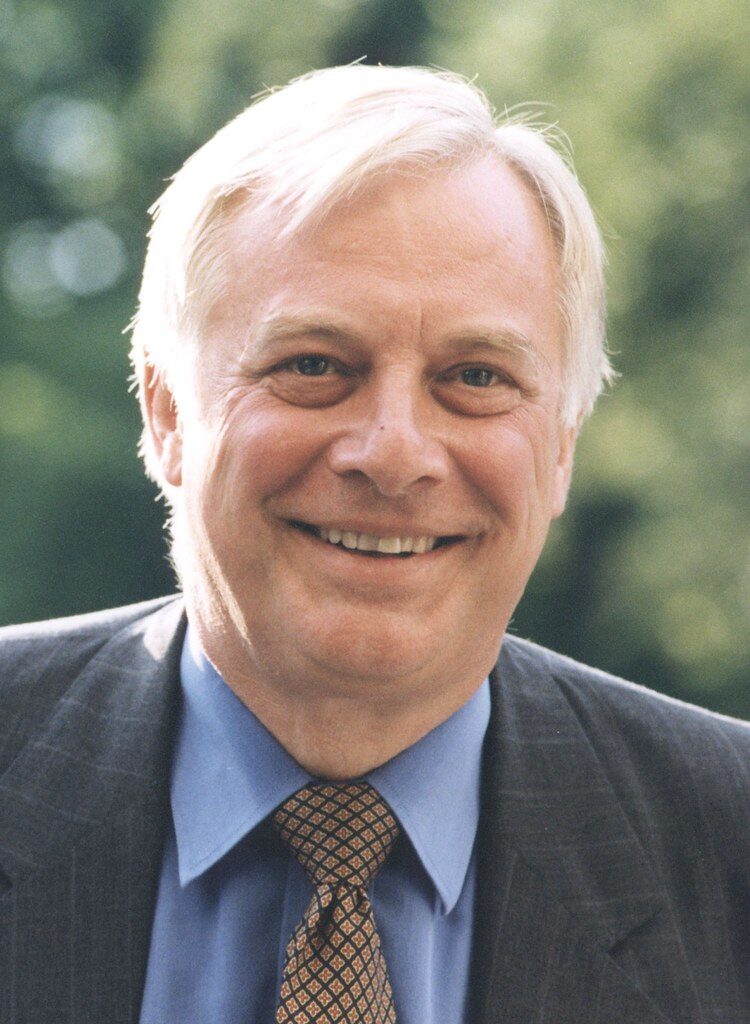
Professor Graham Spencer is Emeritus Professor at Portsmouth University. Lord Patten was the chair of the independent commission on policing for Northern Ireland. This interview was conducted in 2015.
“When did you first get contacted about working on a report and how was the rest of the team decided?
I was phoned when I was in New York giving a lecture on Hong Kong just after Easter of 1998 by a mutual friend who had been talking to the then Secretary of State. She had asked him whether he thought there was any chance of me agreeing to chair this inquiry and committee and the way she put it was what classical students would have called a non-question because she assumed I wouldn’t want to do it. That is what everybody was telling her because it was thought to be, to use a cliché, a poison chalice. But I asked her to call me about it and she did almost immediately at the hotel I was staying in. It was the one issue the political parties had not managed to resolve in the Belfast Agreement. I said I would be happy to do it then she said ‘But everybody tells me it will be a nightmare, don’t you even want to ask your wife?’ and I said well if I ask my wife she will certainly think I should do it because we both feel quite a commitment to Northern Ireland.
She asked me to well think about it a bit more, which I duly did and when I got back from New York I phoned her and said I would like to do it so what is the deal? She told me that they had already picked most of the team which was not ideal and afterwards, in a note I wrote about the process of committees like that, I did make the point that whoever was chairing a committee should have a say and at least a chance of discussing members of the team. So they had been pretty well put in place in a sort of jigsaw negotiation with the Dublin government. This was so that there was a proper balance between what were thought to be republican sympathisers and nationalist sympathisers and unionists and a degree of external expertise as well.
We had a head of a police college in New York who was thought to have been put there by Dublin because he was believed to have republican and nationalist sympathies. There was another acting police woman Kathy O’Toole who if anybody had a view of her being there because of her political sympathies would have completely misjudged her because she was a hugely balanced and intelligent person on policing. From Northern Ireland we had Maurice Hayes who represented as it were the nationalist tradition and Peter Smith who had been quite a prominent member of the Unionist Council and a barrister who was thought to represent the unionist side of the argument. I know that at least one prominent unionist academic had turned it down on the grounds that it was a bed of nails. He subsequently turned out to be a critic of what we had done which I always thought was slightly dishonourable having turned down the opportunity of being on the committee himself. And then there were one or two others such as a South African lawyer and so on.
I had more of a say in choosing the officials who looked after the committee and, in particular, an outstanding civil servant called Bob Pierce who worked with me in Hong Kong. He is one of the cleverest men I have ever had working for me and I wanted him involved. I wanted him as the secretary of the committee and I had a team drawn from the RUC and the home department officials in Northern Ireland to assist. So I decided those positions but the actual membership of the committee was largely determined as a process of negotiation between Belfast and Dublin. I had meetings not only with the Secretary of State who I always believed was an extremely courageous and straight woman, but it was Tony Blair who made it clear to me that our recommendations, and this had been part of the Belfast Agreement, would be accepted by both sides and by the government. As it turned out that wasn’t quite how things played. But that is the background to it and we decided how we would work and how often we would work. I wanted to get the report over and done with within a year or so. So we had to set a pretty smart pace. I had a background in Northern Ireland and also in negotiation and diplomacy but I had absolutely no background in policing or security issues. However, we had a sufficiently professional team to cover all those points.
Did people try to use your background in Northern Ireland as an indication that you wouldn’t be independent?
There was a bit of suspicion on the unionist side because I am a Catholic and there was a bit of suspicion on the republican side because I am a conservative and had been chairman of the Conservative Party. I had spent two years as a junior minister in Northern Ireland and was looked after by four policemen. I was on a list of targets as one of ten, drawn up by the IRA in the mid-1980s so I had form and I had been threatened but I don’t think there was very much animosity to me personally in Ireland or Northern Ireland. I think there was some animosity on the unionist side though I had quite good relations within individual unionist members, not with David Trimble, but with others and there was some criticism on the right of the Conservative Party. I remember Norman Tebbit saying why was I doing this? It had to be for thirty pieces of silver. I also had others saying it was disgraceful that I was helping the Labour Party to get themselves out of a difficult corner. But I think it was a big national issue and I had no hesitation at all in taking it on.
You put a lot of emphasis on public meetings in the early months. How important were formal and informal meetings in terms of difference?
I had informal meetings with the leaders of the parties and particularly the unionists and the republicans, Sinn Fein. We also had to have a sort of informal relationship or an informal understanding with the paramilitaries. When I went to Northern Ireland I said I couldn’t possibly be driven around Northern Ireland by a policeman with bodyguards. We were looking at the future of the police and I thought it would (a) look very curious and (b) put whoever was with me in a very difficult position. So it was made clear to both sides informally that if I wasn’t going to have bodyguards they had to be on their best behaviour. There was a sort of, if you can put it this way, a gentlemen’s agreement that they wouldn’t try to blow me up or any of my team. I went to Crossmaglen with a couple of my colleagues and think I am probably the only British minister, or ex-British minister, to have been to Crossmaglen which has a history that goes well back into the Middle Ages for banditry. As not for the minuted meetings that we had but informal but fairly official meetings I had with Gerry Adams, Martin McGuinness, David Trimble and Ken Maginniss, I never gave them any undertakings.
The republicans were absolutely adamant that we had to wind up the RUC and start again or at the very least that we had to go through a period in which every police officer would be examined by an independent human rights assessment to check that they were squeaky clean. On the unionist side it was no change, it had to remain the RUC and it would be disgraceful if a body that had suffered so many casualties was tainted with any suggestion that it had not acted with integrity and responsibility for all those years. I gave no undertakings about that with them. I said we had come out with an attempt, first of all, to get the police service out of the centre of politics and secondly to establish a police service in which it was possible to recruit more young Catholics because 93% to 7% was not a reasonable balance. When we produced our report David Trimble was under pressure from some of his more extreme supporters but very much out of line with what the police constables and the Belfast Telegraph were saying. He denounced it and said I had promised he would see the report before it was published so that he could, as it were, veto it. The idea that I would have agreed to one of the political parties that they could veto our recommendations is absurd, but I did tell him that I would talk to him and other party leaders about what was in the report before it was published, which we did. The republican side moved from a position in which there had to be either the destruction of the RUC or drawing on Catholic theology for a period of lustration.
What does that mean?
I imagine it means a combination of confession and rebaptism. I had never heard the word before.
Do you think they used that because they knew you were Catholic?
Yes, probably. They moved from that to what became, after we produced our report – ‘We want Patten and nothing but Patten’ – which was quite amusing for me because at one stage they had tried to blow me up. The unionists and the RUC themselves were not destructive. The chief constable ensured that his officers were very open with us but there was quite a lot under the carpet which was quite difficult to get at.
What do you mean?
I will give you two examples. First of all pretty well every serving RUC officer we talked to referred to the Special Branch as ‘a force within a force’ that was thought to operate to a considerable extent independently of the RUC and was resourced in comparison. I think there were something like eight hundred members of Special Branch, Secondly, we were aware of a history of shoot to kill cases and the murder of republican sympathisers who were sometimes lawyers or just involved with a republican cause. This raised questions over the years and we had one of our members, Peter Smith, spend a very long time looking at all the documentation which had been produced for Lord Stevens in Newcastle when he did an inquiry. We weren’t there to investigate the history of the RUC but we were trying to make some general conclusions on what we thought may have happened in the past and I think we got that balance just about right. Peter Smith took a huge burden as an occasional judge and a very high quality barrister in going through all that work.
So to get back to your question I think the informal contacts that we had with people who we would also have been talking to formally were helpful but they weren’t decisive. Except in one instance. I wanted both the government in London and the government in Dublin to know that we weren’t going off the rails. To know the sort of direction in which we wanted to travel and how we would work. I never discussed with them the details of what we were proposing but I did give them an overall idea of what our approach was and that involved a couple of meetings with the Secretary of State or the Prime Minister. It also involved a couple of meetings with Bertie Ahern which he kept absolutely discreet in his constituency office in Dublin. I dealt with him then and subsequently when I was a European Commissioner and he was absolutely straight and sensible; very smart to his fingertips politician who, along with Tony Blair, would be decisive in getting the Belfast Agreement off the ground. I should mention one other series of contacts that we had both formally with the whole committee and individually and that was with church leaders. I was a bit disappointed that we didn’t have more active support even when we produced our report from some of the Catholic hierarchy in urging young Catholics to join the police service. That happened eventually but it was a paradox that the Gaelic Athletic Association was more positive about our proposals in public initially than the Catholic hierarchy.
Why was that?
I don’t know but I think they were very nervous and cautious about whether we might go too far. But the GAA were adamant when we produced our report that young Catholics should now join this new service. Let me add something else. The informal contacts that I was having with people that we would have spoken to formally were also had by all the members of my committee, particularly one or two of them who were extremely active. Kathy O’Toole, for example, was going around and talking particularly to members of the Catholic community being a Catholic from Boston herself. Those kind of contacts proved helpful for the team.
Do you think that members of the public contributed to the process?
Yes that was the point of the public meetings and why we said we would have those meetings. In the end we had about forty.
What were they like?
We were told that nobody would come but came in big numbers. One thing which made them more nerve-racking was that I said we shouldn’t chair them but that they should be chaired by a local member of the community who was acceptable to both sides.
Why did you suggest that?
Because I didn’t want people to think it was just a pro-forma effort that we would control. I wanted it to be the local communities doing it. I think the first one we did was Omagh and it was about two months after the bombing.
Was that your choice?
No. You would go into a community hall and you could cut the atmosphere with a knife and I don’t want to overstate it but it became a sort of truth and reconciliation commission where you would get both communities standing up and telling us terrible stories about their experiences. I remember one evening we did two, one in Portadown and one in Craigavon. The one in Portadown was attended by a lot of the hard men and Portadown was a very raw community then. Some of the hard men were there and there was a very tough guy who was organising protests against the Orange Lodge marches through Portadown. It was potentially a very hostile atmosphere and some terrible stories were told but the meeting was extraordinarily well chaired by a local solicitor called Rosemary Nelson who was murdered by the paramilitaries about a month later.
The paradox was we went straight from there to Craigavon which isn’t very far and we had a mirror image of the meeting. We had three police widows in a row who got up and spoke about the RUC and how appalling it would be if we produced a report which appeared to blanket criticise them The last one who got up was the widow of the last police officer to be shot by the IRA and the police knew who did it and indeed had arrested the person who did it but he had got off on a technicality and guess who his lawyer was, Rosemary Nelson. It was one of my experiences the whole time in Northern Ireland that what people from the outside don’t understand, and it must be the same in parts of the Balkans and Syria today, is the intimacy of the violence.
Sometimes I would be on my own and have two or three people with me. Sometimes someone else would do the meeting but I did most of them and I was doing one with Maurice Hayes in a little fishing village. There was a Protestant community of farmers and a Catholic community of fishermen and we had a meeting in village cinema like from the film “Cinema Paradiso”. We were up on quite a high stage with a local minister who was chairing the meeting and again the hall was packed with some five hundred people. It was absolutely split evenly down the middle. It had been a long day and evening and I was looking forward to going back to Hillsborough for fish and chips and a large glass of whiskey. So I make a little speech about the process and the importance of building on the Belfast Agreement and what we were doing being a part of reconciliation and that Northern Ireland could be so much better in the future and it’s always a speaker’s worst fear when somebody at the back of the hall after you think you have wrapped up wants to ask a last question. In this instance it was a lady and she had a tartan hat and coat on and she had her hand up. I said “okay”, we will take one last question from the lady at the back. She got up and said ‘Thank you for that Mr Patten but it’s all very well for you. You come over here from a nice house in London and you are comfortably looked after and you give these little speeches about reconciliation but I want to tell you how difficult it is for us.’ And she lent forward and tapped the man a couple of rows ahead jof her on his shoulder and said ‘That man there killed my son’ and this was true. Everyone told me afterwards that he had been one of those let out as part of the Belfast Agreement.
I don’t think people understand the rawness of those emotions and when, for example, you can be in the queue in a supermarket and see somebody in the next queue who killed your uncle or whose uncle you killed. Those communities somehow manage to live in such intimacy with so many experiences that they share but one of those experiences is the way in which identity, a sense of victim-hood, transcends any notion of civic humanism.
Some of my jobs in politics have oddly been about this subject of identity politics; Hong Kong Chinese and politics in the Balkans, politics in Northern Ireland and they are lethal. The public meetings were a big part not only of the way we managed the process to ensure that we had the maximum political credibility but also a way in which we tried to open up the discussion and get people to focus on the fact that at the heart of our report there would have to be a degree of give and take.
If you look at the report yes it is about policing but it’s policing in relation. Where does the ground lay for how that influences what you end up with?
Everybody contributed to the text. I wrote the first couple of chapters which were part of the philosophy and background that I wanted to get right and Bob was the main draftsman for the rest. At the heart of my understanding of the situation after the Belfast Agreement was that partly, because of exhaustion on both sides, there was a tacit bargain. The republicans would give up trying to bomb their way to changing the constitutional status of Northern Ireland and would settle for the ballot box provided that nobody tried to ram the symbols of a unionist state down their throats. And the unionists, on the other hand, would accept them if not as loyal opposition at least as an opposition within the same democratic community and would not seek to assert either in a symbolic or a practical way the dominance of Protestantism and unionism in the community. If you did that there was a good chance of taking the police service, who were left either unionist or Catholic, in the centre of this awful bloody political debate outside that untenable position. We managed to do it and when David Trimble and other unionists turned around and said what are you doing and what is this about my own response was we are doing what you signed up to. We’ve come up with proposals not for a lustrated police service or the abolition of the RUC but a police service with a different name, with different symbols and emblems. How can it be that you accept in the Northern Ireland Assembly that the royal coat of arms won’t be the symbol and that can find some neutral symbol but yet for the RUC you insist on it continuing to look as though it is a representative of the majority community in Northern Ireland? It was not just illogical it was wickedly illogical because it put them in such an impossible position.
How did the two sides understand language in this debate or indeed use it similarly and differently?
Some were adamant that the RUC had to be abolished or at least lustrated. And I think what they understood and settled for at the end of the day, as vicars would say, is that we had actually produced ideas for a police service which would be different and in which there would be more Catholics. Here was a proposal we put in about the way police officers would be recruited in the future. I think that you may be correct about interpretive differences but they weren’t as hung up on words and symbols as some unionists were. There is that old but correct adage about the proof of the pudding. The truth is that it has worked. There are some things that didn’t quite work. If you have very generous pension arrangements and you are trying to reduce the size of a force you tend to lose some of the best people because they are the people who can easily get jobs outside. I think that actually in managing not just the institutional change but personnel change I would now be a bit more focussed on one or two of the optional add-ons like investment in a police training college which took too long to do. But something I was clear about was that we had to have a permanent change agent and manager and that has been a great success. It is important to have someone else around after the report to make sure that it is implemented.
In the report was it clear from the start that a gradual change would not do here? That it had to be done quickly?
The Northern Ireland members of the committee were even more adamant about this than me. You couldn’t say that the RUC had been changed and continue to call it the RUC. There had to be some significant change in the symbols, not flying the flag over every police station in the Bogside and not having the Royal coat of arms or else you would never be able to carry the Catholic community or, more specifically, the republican and nationalist community with you. And I think that was quite a small amount to expect the unionists to swallow.
Talking about public meetings almost becoming like a truth and reconciliation process was also the experience of Denis Bradley and Robin Eames in their work on the past. Did you see those meetings as having a cathartic function too?
Yes it did do that. I’m sure somebody has done a study of what was said at those meetings because they were certainly minuted and some of the stories one heard which had people weeping while getting them off their chest.
Did things get nasty at any point?
Nearly but not quite. People behaved extraordinarily well and I think that was partly because we were not managing them. We made it absolutely clear that it was the community’s meeting and not ours. Sometimes you had chairmen who weren’t all that sophisticated, or competent, in what they were doing but I think if I had been chairing the Portadown meeting rather than Rosemary Nelson it could have got quite difficult.
Were the police more pragmatic than one would expect and were the unionists the rigid ones?
Yes they were. There were some police officers who were very tough but we went round all the police stations and there was a degree of understanding in the police about what needed to change. People knew that you couldn’t prevent every change on the grounds that it was a terrible way of treating all those who, to use the expression, paid the ultimate price for standing up for law and order. That was something we heard over and over again but you would talk to a superintendent in Derry or Londonderry and with that sort of officer you would get a very pragmatic understanding and appreciation of the position he and his men and women were in. We did a bit of work overseas in order to deal with some policing issues. We had a couple of trips to America and talked to quite a few police chiefs there, usually Irish diaspora.
What didn’t affect me but I think if one or two of the DUP had ever found out about it they would have given me hell was that on my father’s side I am from an Irish potato famine immigrant. My father died in his later fifties and my mother remarried an Irish GP. My stepfather’s father had been a member of the Irish Police service, the Royal Irish Constabulary, and had been retired in 1923 because he supported Michael Collins. It didn’t affect what I did but it’s an example of how scrambled identities can be. Look at the names: Adams, McGuinness, Molyneaux. The challenge though is how to assert a sense of civic humanism and common values which transcend any notion of victimhood-driven identity politics. It’s hugely important and at the root of a lot of the things we are bothered about today.
Is it not important that to deal with the past well you have to do it in relation to a future that benefits as many as possible?
Louis McNiece’s father was a Church of Ireland bishop and after some riots in Belfast said ‘Remember the past the better to forget it.’
Why use a religious basis to frame the report, that is, a quote from the Catholic Church?
I don’t think that I had a real sense or any of us had a sense of reflecting St Matthew’s Gospel but inevitably you are once you are talking about hunger and thirst for righteousness and justice. Once you are talking about generosity, mercy the things that the Pope prefers to talk about rather than contraception and divorce which is pastorally extremely important.
Did you give any particular attention to areas where the bubbling of trouble and violence might be more likely to arise from or was the process more wide open?
It was pretty wide open but when you talk about smaller parts of the community which we paid attention to I think that there were, of course, individual members of the main churches who were very significant in working for peace and working for reconciliation but it I had to choose two of the smaller religious groups who I think played a wonderfully positive role in all that one would be the Methodists and the other the Quakers.
Why is that? Is it to do with power?
A bit and it’s to do with the way in which churches can be so institutionalised. There is wonderful book by Alan Massie called ‘A Question of Loyalties’ which is a novel about France and Germany and somebody in that book says something like ‘Would you describe yourself as a good Catholic’ and other person replies ‘well I suppose to be a good Catholic you have to follow all the observancies and I do that but what I find as I get older is that I am more and more shocked by the way that it’s the institution that seems to be a central part of the argument rather than Jesus Christ’ and it’s a very profound point about all religions, the way they get locked into defending the institution, and become, in a sense, politicised.
A major difference between unionists and Catholics is where unionists focus on individual responsibility and for republicans it’s more about understanding context and circumstances.
Up to a point but when you read the role that one or two priests played in encouraging the hunger strikers to go on refusing food that is unforgivable in order not to let their family down, in order to make a political point. I have been angered many times in my life being a Catholic by signs of triumphalism or the ability of some people in the Catholic Church to put the interests of the church or the perceived herd-like quality of the community above anything else. One of the things I have written about which most shocked me was Mostar in Bosnia which was a wonderful old Muslim city with Croatians on one side of the city and the high land above and this beautiful old city with a famous bridge over it and basically during the Yugoslavia wars and the Croatians flattened the Muslim part of the city now it’s part of the partial reconciliation in Bosnia. Mostar has been rebuilt including the bridge but above it on the high land is this huge crucifix and maybe it wasn’t intentional but it’s a sort of sign of triumph ad I think that needs to be avoided.
Did the republicans make life difficult for the unionists when the report came out?
When the Secretary of State had changed to Peter Mandelson he was keen to keep the unionists onside and he thought that he could outsmart our report and find ways of squaring circles and avoiding changing the police service from the RUC to the PSNI. He tried to prevent symbols changing and did so with a bit of legislation that was brought in. But the republicans made such a fuss that he had to back off. That was when the republicans and the nationalists and people like John Hume and Seamus Mallon were saying this interference was not the deal. You get an independent group to write a report and then you try to fillet it and that is unacceptable. They went back to the original agreement and Peter Mandelson wasn’t able to find a way where he could square the circle when it came to agreed basic principles.
When it was published was it job done?
That was it and I hardly spoke about it afterwards.
LORD PATTEN WAS THE CHAIR OF THE INDEPENDENT COMMISSION ON POLICING FOR NORTHERN IRELAND.
Discover more from Policing The Peace
Subscribe to get the latest posts sent to your email.