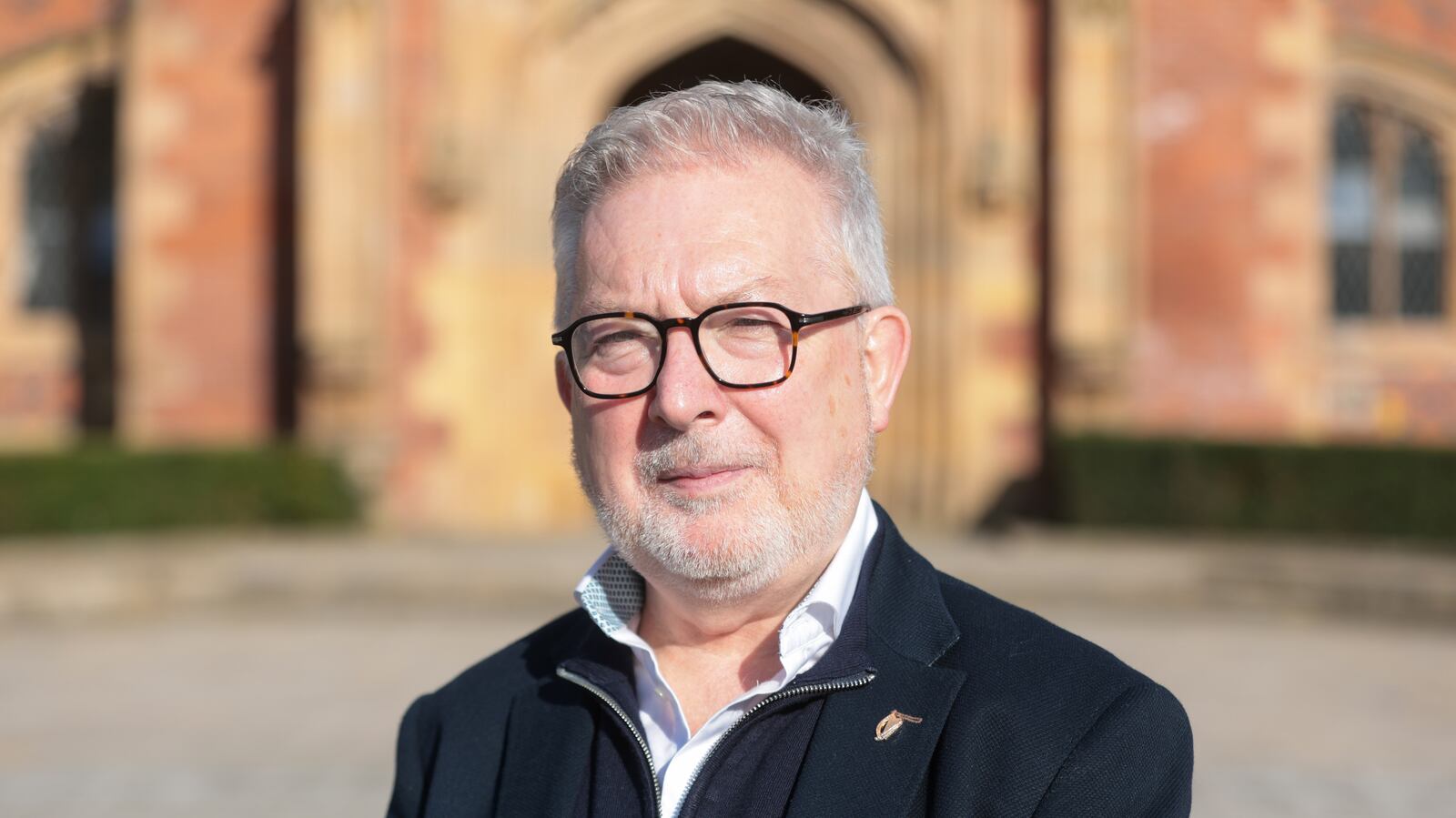
Tom Kelly was a member of the 1st NI Policing Board
My earliest memory of policing dates back to 1976. I was climbing a tree on the town’s edge when I found a cache of ammunition. I promptly handed it to my maternal granny. Despite her staunch nationalist views, she marched me to Newry RUC Station in Corry Square. She had English grandchildren in the UK Amed Forces and a few relatives involved in the Republican cause. But she often remarked on anyone’s death due to the Troubles, saying, “That’s some mother’s son.”
The experience at the RUC station was completely alien to me, especially the officers. I was only twelve. Not only did my age not protect me from hours of questioning, but unbeknownst to my granny, I was also taken back to the ammunition dump in an armoured police Land Rover all in full view of passers-by. Terrified, I feared punishment from the IRA for cooperating with the RUC or being labelled a tout! That day, I resolved never to support the RUC.
In truth, I had only known one police officer: Neal Quinn, who lived three doors from my paternal grandparents’ house. Mr Quinn was a Catholic and a pleasant guy. He once gave me ten shillings after I won a fancy-dress competition dressed as an NYC cop! Tragically, he was murdered in the Bridge Bar in 1981, a place I would visit regularly in the future. As far as I recall, he was the last RUC man to live in Newry. I remember his death because his sons were ahead of me in the Abbey and his daughter was my friend. Sadly, the family moved away after his murder.
Fast forward to November 1986, as the song aptly describes, “times were a changing.” I had just returned from the USA to work for the newly elected MP Seamus Mallon. To me, Mallon was a legend – relentless in his fearless pursuit of justice, seeking policing reform and demanding the abolition of the UDR and part-time RUC Reserve.
Local tensions were already high, especially after another failed mortar attack on Corry Square barracks. This more recent attack resulted in 39 civilian injuries and significant damage to private and commercial property. The previous year’s IRA mortar attack had killed numerous officers and injured many more, making it the single greatest loss suffered by the RUC.
Relations between Newry residents and the RUC were virtually non-existent.
The Derrybeg estate, steeped in pain and turmoil during the early Troubles, was close to my home on Armagh Road.
One day soldiers from the Royal Hampshire Regiment, accompanied by a RUC patrol, were walking through the estate. They fired shots above the heads of some children who had thrown stones at them. The mothers of the children demanded the MP take action and I was sent to meet them.
With a sense of chutzpah, I decided to take their case directly to the police, accompanied by the angry mothers. However, my optimism quickly faded when the police sergeant refused to let me in unless I left the mothers outside.
There was more chance of hell freezing over!
I demanded to be heard but was forced to settle for stating our constituents’ case from outside the fortification to the sergeant through the Sanger. It was a rude awakening to the RUC’s hardening attitude towards nationalist Members of Parliament, but I knew they would eventually have to adapt. Mallon was going nowhere and his famous phrase, “If we sort policing in the North- the politics will fall into place,” encapsulated his resolve. The RUC was simply not a symbiotic partner of unionist hegemony and supremacy; they were their armed enforcers.
A reader might reasonably ask, but all of this happened in the past – what’s the point?
The aim is to contextualise the profound estrangement between the RUC and the nationalist community and the nearly two-generation transformation needed for policing to be accepted in the North. Much of this estrangement stems from self-inflicted wounds by the then policing leadership and external pressures from unionism, loyal orders and British securocrats.
At 12, I would have scoffed at the idea of helping shape policing reform or even joining the police service’s oversight. However, when the Patton proposals led to a new policing service and oversight board, I felt compelled to take a stand in “getting policing sorted”.
When the last RUC Chief Constable, Ronnie Flanagan invited me to advise his transition management team, I was skeptical. My old boss Seamus Mallon quietly encouraged my involvement. He was less enthusiastic when, as a nationalist and former Vice-Chair of the SDLP, I announced my support for the direction of travel as the Patten proposals were implemented and I would join the new Policing Board before the SDLP formally endorsed the move. Mallon and his colleagues didn’t doubt the sincerity of police leadership then as much as they mistrusted the then Secretary of State Peter Mandelson. Their mistrust proved well-founded!
The new Policing Board, under the guidance of inaugural chairman Sir Desmond Rea and Vice-Chair Denis Bradley, was blessed in its stewardship. I’ve likened them to Felix Unger and Oscar Madison of politics and policing diplomacy. The Board members were earnest in their desire to succeed, despite or perhaps because of their political differences. Sammy Wilson and Alex Attwood provided a good balance. The role of independents was crucial in the first Board helping to overcome some entrenched beliefs and prejudices, both unionist and nationalist.
My journey in politics, public life and policing reform has been long and sometimes, even significant.
I’m the grandson of my namesake, an IRA War of Independence veteran. He was arrested and beaten by police and Black and Tans and sentenced to fifteen years in a court-martial. He was imprisoned in Crumlin Road and later exiled to Dublin after the Truce.
Despite this, I found myself on the same board, jointly overseeing and holding policing in Northern Ireland to account, with Alan (Viscount) Brookeborough. Brookeborough was the grandson of Northern Ireland’s 3rd Prime Minister. He had in the 1930s declared he would not employ a Catholic on his estate and held cabinet office for a record-breaking 33 years.
Did I make the right decision in backing Patten reforms and giving policing in the North a fresh start? Absolutely. Perhaps in a small way, it gave me an opportunity to show the late Constable Neal Quinn that his ten shillings was well invested.
Discover more from Policing The Peace
Subscribe to get the latest posts sent to your email.